10.01.2026

Historic Church Interior Renovation/Restoration: Start with the Old Wood


Historic Church Interior Renovation/Restoration: Start with the Old Wood

Commentary


St Anthony Church Athens, WI


The most popular church interior decorative companies—and many of the best-known liturgical designers—are getting it wrong when it comes to historic sacred spaces.

The reason is relatively simple: they see the interior of the church as their entire realm. They don't necessarily consider the original building’s architecture, shapes, or period.

When a church decorator enters a sanctuary, they tend to see the aspects of that sanctuary that relate directly to their trade. Thus, they prioritize what they can provide (ie decorative paint, murals, gold leaf, fabrics, etc.).

In an old church they tend to initially look past all the existing old wood.

It's almost as though it isn't there.

The historic wood becomes an afterthought.

As such, the aged wood is then decorated (nearly painted) to match their proposed decorative scheme rather than being understood as one of the defining elements of the historic interior.

I've seen this repeatedly.

The decorative scheme is established first. Then the historic woodwork is expected to accommodate it.

That is essentially the circumstance we've learned to accept.

But it doesn't have to be that way.

A Different Way of Thinking

I recently worked on a project where the priest thought about the building in a completely different manner.

Some might refer to his way of thinking as having a "beautiful mind," because it recognizes something that can easily be lost in the process of renovating an old church: the building itself has something to say.

Normally, when we come into a church project, the entire decorative scheme has already been created. Even when we're doing a restoration project for the pews—something that ideally would allow the historic wood to stand on its own—we nonetheless look for ways to slightly skew the restoration so that it has harmony with the already chosen decorative theme.

That is the circumstance we've learned to accept over time.

So when I realized that this priest was prioritizing the original historic interior wood of his 140-year-old church before considering anything else, at first I was incredulous.

Then I thought about it.

And it changed the way I looked at my own work.

It helped me realize that my craft didn’t have to be subordinate.

More importantly, it helped me realize that in an historic church, proper restoration of the historic wood can actually be where an interior renovation can start.

The Pew Is Different


This becomes particularly important when you consider the church pew.

Pews occupy the ground level of the church. They exist at the human level.

Almost every other aspect of church interior decoration is primarily something you gaze at from a distance.

Your old pews are different.

You are literally amongst them.

You touch them. Slide across them.

You grab the wooden top rail of the pew in front of you to help yourself stand.

You feel the wood beneath your hands.

And the sheer amount of wood present in a historic church can be almost overwhelming.

That physical presence matters.

It's one reason that when you look at many church interior decorating proposals, the designer's perspective is often directed upward, with perhaps only the tops of the pews appearing in the frame.

But the pews aren't merely something occupying the bottom of the picture.

They are one of the largest—and most tactile—elements of the room.

They are a “humanly intimate” part of the historic church  experience.

Start With the Wood


St Mary Church Appleton, WI


The first question should be: What is already here?

Before deciding what the interior should look like, examine what the church originally was.

If wood is the predominant element in a historic church, perhaps that is what you lead with.

Then everything else can have continuity with it.

The result is not necessarily a recreation of the past. It is something more subtle: an interior in which the new work respects the existing architecture rather than competing with it.

Starting with the wood restoration changes the entire perspective on interior decoration.

Instead of asking, "What do we want this church to look like?" begin by asking, "What does this church already have? What can be retained, restored, and integrated into the life of the church today?”

It is about recognizing that a historic church is not a blank interior waiting for the next decorative trend.

It is an existing work of architecture with a long history of worship and it’s material language should reflect that.

The goal should not be to force that building into today's idea of what a church ought to look like.

The goal should be to create harmony with the current and the past.

Start with the wood.

Then let everything else follow.


V Scott Beddome


church, church decorators, decoration, historic, historic church, historic church decoration, historic church renovation, Historic church restoration, liturgical design, preservation, renovation, restoration, sacred space

Historic Church Renovation/Decoration: Creating Continuity with the Existing Architecture


Historic Church Renovation:

Creating Continuity with the Existing Architecture

A commentary on historic church interior design, restoration and preservation.


There is a fundamental problem with the way many historic church renovation projects are approached today: the interior is often treated as though it exists independently of the building that contains it.

It doesn't.

When you walk up to the faΓ§ade of an old church, you naturally anticipate what the interior will be like. The architecture establishes an expectation. Its scale, shapes, proportions, materials, and period tell you something about what should exist beyond the heavy wooden entrance doors.

Yet contemporary church decorating can create a disconnect between the exterior and the interior.

The existing architecture becomes a shell, while the interior is redesigned according to whatever happens to be the current decorative trend.

And increasingly, that means that church decorators end up proposing the same currently popular scheme from church to church repeatedly until that trend dies.

The Building Has a History


The Mariners Church Detroit, MI (circa 1840)


The problem begins when the people designing the interior see only the aspects of the sanctuary that relate to their particular trade.

Painters see surfaces to paint. Decorators see colors and fabrics. Designers see a palette and a composition.

But a historic church is more than the sum of those elements.

It is an existing building with an existing architectural language.

That means the first step should be understanding what the church originally was.

The only time a church's exterior and interior are perfectly aligned with each other is when the church is first built. That doesn't mean that a historic church has to remain frozen in that original moment. It does mean that the original relationship between the exterior, the interior, the architecture, and the materials can help us understand the building.

The objective isn't necessarily to recreate the past.

It is to maintain continuity with it.

That distinction matters.

Continuity Doesn't Mean Re-creation

A church that is 140 years old has lived a life since the day it was constructed.

Its worship has changed. Its congregation has changed. Its needs have changed.


The interior may have changed many times.

So the question isn't simply, "What did this church look like when it was built?"

The more useful question is, "What is the character of this building, and how can today's work remain in conversation with it?"

That requires looking at the existing historic elements as more than obstacles to a new decorative scheme.

It means identifying the interior architectural components that still have value and determining what can be retained without interfering with the liturgy or the action taking place in the space.

When that happens, contemporary needs and historic architecture don't have to be enemies.

They can coexist.

The 1970s and 1980s Problem

This is particularly relevant to a current trend toward putting Gothic interiors into churches built during the 1970s and 1980s.

I understand why this is happening.

The stripping away of ornate interiors in the 1970s and '80s, particularly in response to changes following Vatican II, left many churches with interiors that their congregations now feel have lost something important.

There is a historical reaction taking place.

In a broader architectural sense, it is another version of the Bauhaus minimalist response to the superfluous decoration of Victorianism and beautifully elaborate Art Nouveau: one period rejecting the aesthetic of another.

But the response can create another problem.

When a Gothic interior is inserted into a 1970s or 1980s church, the architecture of that later period can be treated as though it has no value whatsoever.

There are many more recent churches whose architecture may not yet be considered historic. But that does not mean their existing architecture can simply be denied.

Every period produces buildings that eventually become part of architectural history.

The fact that we may not yet have enough distance from a particular period to call its buildings "historic" doesn't mean that those buildings have no architectural value.

Preservation and the Life of the Church


Divine Word Church Techny, IL 


There has been an ongoing battle between liturgical needs and historic preservation for too long.

And there really doesn't need to be.

The important and “contributing” historic elements of a sacred space can be retained without interfering with the liturgy. The existing architecture doesn't have to be treated as an obstacle

Preservationists don't have to be treated as a threat.

And decoration doesn't have to erase what came before it.

In fact, understanding and preserving those elements can create a deeper relationship between the building and the people who worship within it.

A long history of worship in a beautiful sacred space is a different experience because it connects the present congregation with the people who came before them.

Your community is greater than just those who currently attend.

It includes everyone who has attended that space throughout its history.

And it includes everyone who shares your beliefs, past and present.

That is the larger meaning of continuity.

A historic church is not simply an old building that happens to contain a contemporary congregation.

It is a place where the present exists within a much longer story.

The challenge is for the church to continue to be an active, vibrant place in the community where people come and go often.

It’s a continuing story.

When the existing architecture is understood first, the interior and exterior can once again have a sense of belonging to one another.


The same can be said of the people of the past and the people of the present.

Your Sacred Space is saying something.

Our job is to listen to it.


V Scott Beddome


Church, renovation, historic, restoration, preservation, historic church, decoration, liturgical design, church decorators,  

9.16.2026

Church Pew Restoration vs Church Pew Refinishing: What's the difference?


Church Pew Restoration vs Church Pew Refinishing: What's the difference?

In short, the difference is dramatic.

Why?

It's because the process and outcome of each call for an entirely different set of parameters.

One puts the cart before the horse. The other is the horse.


Church Pew Refinishing


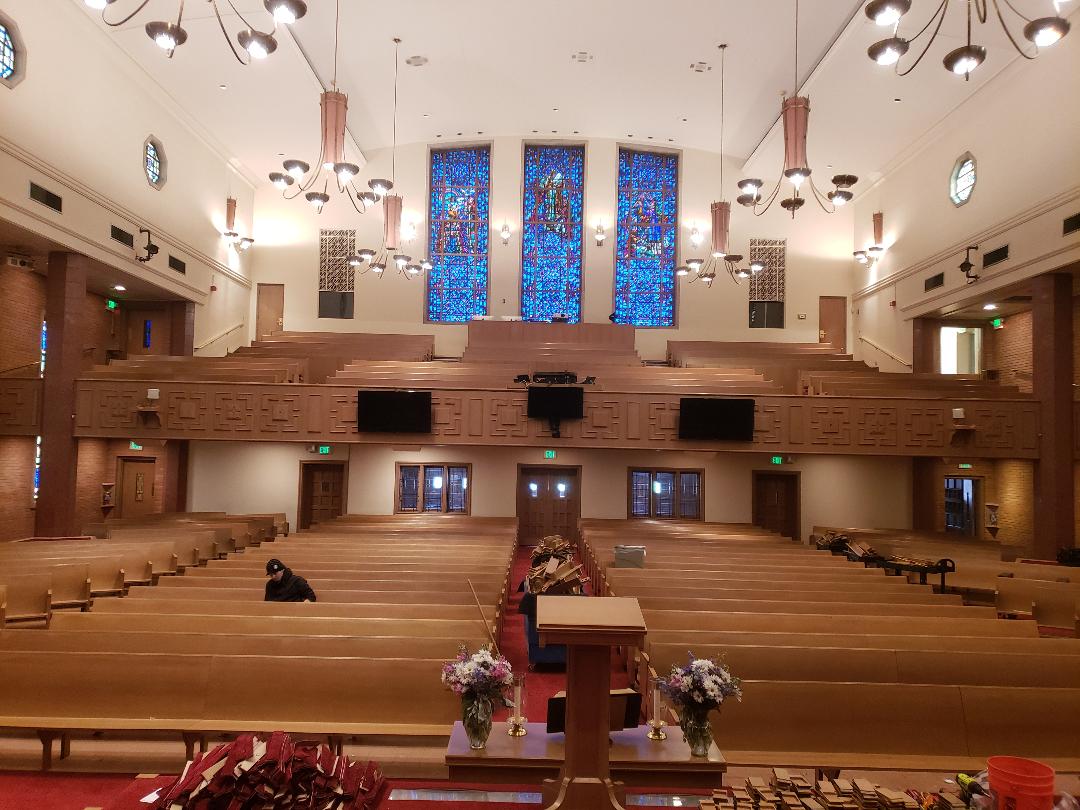
St Sebastian. Akron, Ohio- Redecoration to match.


Church Pew Refinishing is what you do when the interior design is the primary factor. You decorate the church pew wood to be cohesive with the (usually) predetermined full interior palette.

Most of the time that is a mood board or concept board that had as its' priorities the paint colors, fabric swatches, tiles, etc. If it even contains a wood sample it’s generally an afterthought.

The pew finishes are subordinate to the design. After all, it's just "seating."

This is more likely to be the case in recently built structures where they are "updating" the outmoded original decorative theme to current trends.

Thus, Church Pew Refinishing just needs to match.

So, the pew finishes for church renovation projects are nearly always heavily opaque and two dimensional.

Painted.

That's what you have to do to make them match.


Ok so now the fun part.

______________________________________________

Church Pew Restoration


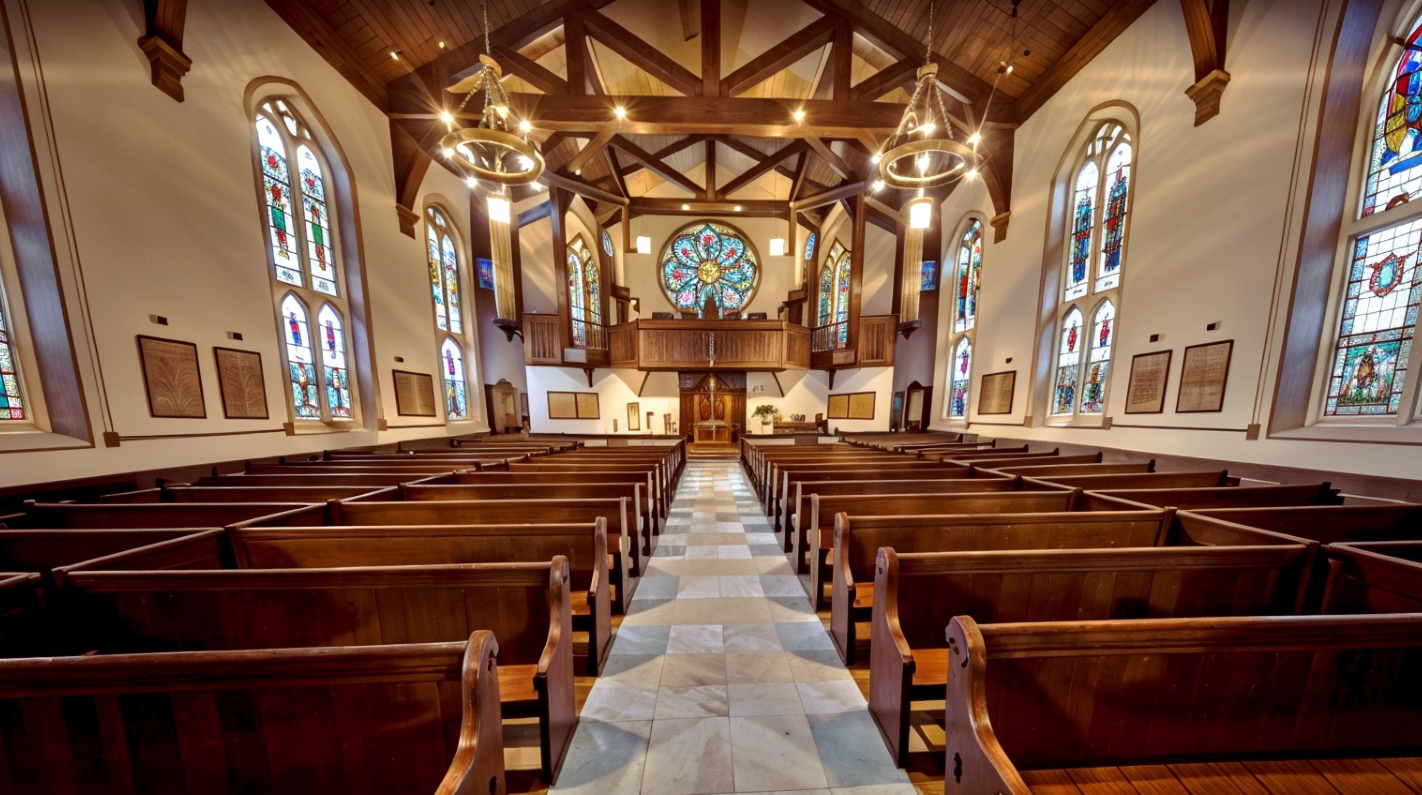
The Mariners Church, Detroit- BEFORE.


Church Pew Restoration must consider an awful lot more.

We'll start with history.

When you walk into an old church do you expect to see everything looking new?

Nope.

But that happens to many Sacred Spaces that have fallen into the redecoration rabbit hole over time.

What you tend to see is a hodgepodge mix of the many previous decorations.

They did this blond in the 1950's, that dark walnut in the '70's, the gorgeous Mauve wall paint in the 80's and it hasn't been touched since.

So, the entire format for what needs to be done isn't merely interior design.

You can't fight the original church architecture. You can't change its' shapes or materials.

And rightly so.

The only time in the decorative history of the church when everything was perfect was when it was first built.


So, what was it like then?

It's not that you want to replicate the original now. But that initial design is helpful when you are beginning to decide how to make the adulterated historic interior cohesive with the original architecture.

It's a starting point.

The interior wood components, though, have different considerations.

Old wood in an old church shouldn't look "like new" should it?

Aged wood in an old building is a testament, a marker, to its time on earth.

In a Sacred Space the old wood is a reminder of its' long history of worship.

Proof that it’s been a vibrant place in the community where people have been coming and going for a very long time.

(Think about all the actions that have taken place there... funerals, baptisms, weddings, celebrations).


Ok, yeah, but what does this have to do with the Church Pew Restoration?

To determine the goal of a restorative finish aesthetic for old pews in an old church you must take the entire building into account.

That's why we ask potential clients to send us photos that include the exterior AND the full interior.

We want to get an idea of the era and the status of things.

All that matters.

(Overthinking the pews a bit, eh?)


A full church redecoration

A full church redecoration almost always has its' priorities on things that are only visual.

The stained glass, wall paint decoration, murals, etc.

The pews are down on the "human" level.

You sit in the pews. Slide across them. Touch them.

And the actual physical mass of them is quite impactful.


(Notice the proposed redecoration renderings are always looking upward...)


So how do you determine what the old historic wood church pews should look like?


You must first recognize and prioritize the original architectural components that remain.

The wood ceiling beams, wainscoting, doors and frames, balcony half wall, altars, communion rail and organ pipe housing just for a start.

Are the finishes original? Aged? Or have they been "refinished" in the past?

What are the interior existing wood "orphans." The late additions that don't seem to fit any era or purpose anymore.


Most importantly, you must seek out pristine original finish.


Pristine original finish circa 1840.

It's there. You just need to find it.

It's hidden on chair rails behind original cabinetry or under pew ends or where wood meets wood on door frames.

That finish tells you how the wood would look if damage hadn't happened.

Damage like sun bleaching, refinishing, recoating causing blackened color, etc.

That should be your guide.


Then how do you attain that?


Mariners Church, Detroit - AFTER


Well, then you call us!

(I know. It was just getting interesting.)

Churchpewrestoration.com is the only pew refinishing company that was founded on historic preservation principles.

Principals like The Department of Interiors Guidelines for Rehabilitating Historic Structures that considers the existing wood patina a "contributing historic element."

We do too.

Rescuing the patina buried beneath added layers of surface finishes is our thing.


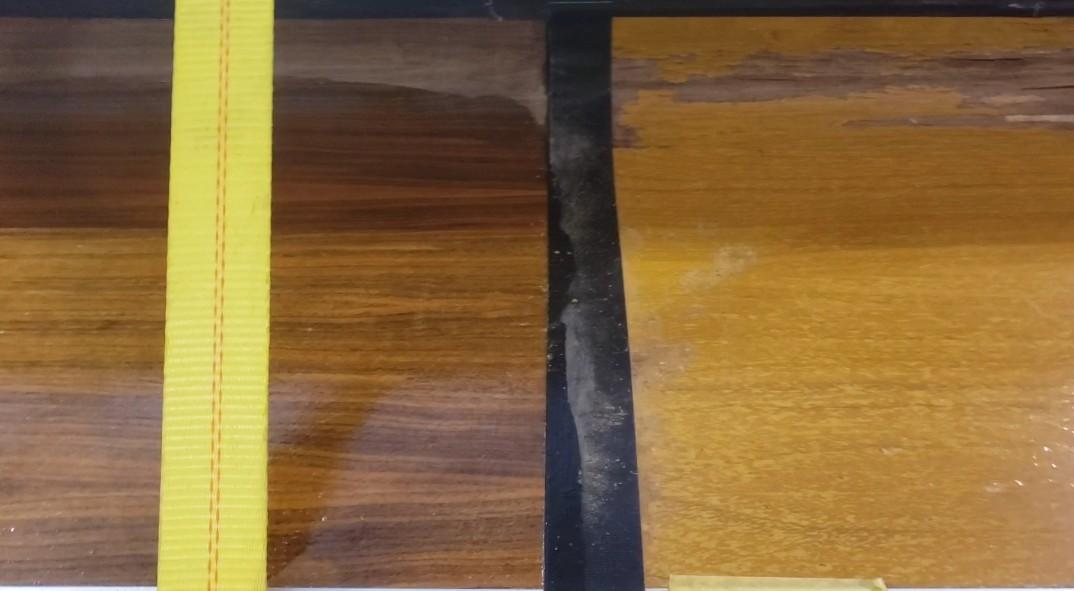
The old finish (spray lacquer) on the right. After gentle finish removal we

 exposed the original walnut patina on the left.


And if the finish has been damaged beyond repair, we can recreate the incandescent warmth of aged wood that will meet the expectations visitors had imagined.


Frank 


Frank Lloyd Wright once said,

"Wood is the most humanly intimate of all materials."

We agree.

And that's what we do.

We make historic church interiors feel better.

One old pew at a time.

Scott

email
or call

PS AI helped with structure and the Frank and the interior rendering but the copy was all just me. Word for word. Unchanged. Like real people do!


8.14.2025

Church Pew and Altar Restoration at The Mariners Church Detroit, MI

In a musty old hall in Detroit they prayed


In the Maritime Sailors' Cathedral


The church bell chimed 'til it rang twenty-nine times


For each man on the Edmund Fitzgerald"


- Gordon Lightfoot
1976


Restoring Sacred Beauty: Mariners Church of Detroit

A Historic Gem Reclaimed

The Mariners Church of Detroit, founded in 1840, is a remarkable example of early American ecclesiastical architecture. Crafted with the precision and care reminiscent of hand-hewn wooden boats, this sacred space is one of the oldest surviving churches in Michigan—and perhaps one of the most underappreciated.
Once a dominant figure on the Detroit skyline, the church’s stature has been visually overshadowed by an unfortunate tower addition and the now underutilized Renaissance Center (RenCen) across the street—a fading monument to the rise and fall of the American auto industry.


But step inside, and everything changes.


A True Sanctuary

The word “sanctuary” takes on its deepest meaning the moment you step through the church’s original, solid wood front doors. The warmth, silence, and rich glow of aged wood immediately envelop you. It feels safe. Peaceful. Sacred.

Inside, the simplicity of the church speaks volumes about its founders’ values. Carved into the heart of its identity is the creed:

“A House of Prayer for All People.”

Even “hobo mariners,” unwelcome in most places at the time, found a seat here. This was a radical stance in an era when church seating reflected social status, often dividing the rich from the poor. The founders believed resources should serve the mission—not edifice embellishment.


Mid-Century Missteps

Unfortunately, as with many historic structures, well-intentioned mid-century updates left their mark.

In the 1950s, many of the ground floor interior wooden surfaces were covered with a “limed” or “blonded” lacquer finish, a popular trend at the time but one that felt out of sync with the church’s age and architecture. This finish dulled the natural beauty of the wood and created a stark contrast with the untouched original wood architectural elements that had survived— ceiling beams, doors, balcony railings—still wearing their 174-year-old patina.

The result? A disjointed, cold interior. One that unintentionally erased the authenticity of the space.


Rediscovering the Original Spirit

Thankfully, the current stewards of Mariners Church understood the importance of historical integrity. They reached out to us to help restore the interior and reconnect it to its true roots.

To begin the process, we created an AI-enhanced rendering to visualize the restoration. 

Then, we spent the summer months carefully executing the transformation—piece by piece.

What we found changed us.


Detroit Surprises Us

We came with limited expectations and left with a deep love for Detroit, its people, and its pizza. We even became Lions fans (who saw that coming?).

But most importantly, we discovered a city fiercely committed to preserving its heritage while building something new. The restoration of Mariners Church felt like part of that larger movement.


The Process: Patience Meets Precision

Wood Discovery

The sanctuary woodwork was revealed to be Mahogany, the same species we had worked with in monumental buildings like the Illinois State Supreme Court and St. Paul City Hall. We knew immediately how stunning the final results could be.

The pews were pegged directly into the floor, and the center dividers sat loose, varying in size and placement. Each component had to be tagged, numbered, and gently dismantled to preserve its integrity.

We discovered a pristine, untouched original finish inside the sacristy—our reference for all restoration work.


Finish Restoration

Our process involved a gentle existing finish “rinse”, designed not to raise the grain or damage the patina. This technique allowed us to bring back the deep, rich glow of the original wood without sanding away its age.

One sample was tested on a pew end, and the results were stunning: warm, authentic, and true to the building’s 19th-century character.


Bringing It All Back Together

The final phase involved: 

Rebuilding and finish restoration of the pews and sanctuary furnishings


Restoring the altar


Applying a hand-applied dry-brush finish to bring out the character of each piece


Seeing it all come together was deeply rewarding.

A Labor of Love

My son and I poured our hearts into this project, and we loved every minute of it. We’re incredibly grateful to have been part of restoring such a special space.

Mariners Church now feels like it should: sacred, historic, welcoming.

And while I'm tempted to hang up my tools after this, I have one question for you:


Can We Help Your Church?

If your historic sanctuary or worship space needs restoration, we’d love to talk.

πŸ“§ Email us
πŸ“ž Call us
πŸ”¨ Let’s bring your space back to life—authentically.


Scott 


Mariners Church Detroit, Historic church restoration, Mahogany wood restoration, Sacred space renovation, 19th century church interior, Detroit architecture history, pew restoration process, Patina wood finish techniques, Church preservation projects


8.13.2025

The Past Year. AF Cadet Academy Chapel & 1st Pres Church

 OK I can die now.

Not to be morbid but geez we have really outdone ourselves over this past year.

First we made great progress on our Air Force Cadet Academy Chapel project in Colorado Springs, CO.


Yea. Woah!!!

Inside.


Is this heaven?

The 2000' of "aero-designed" church pews are a bespoke, one-off design.


They had been sprayed with an opaque lacquer to hide water damage.

We were able to remove only the soiled old orange existing finish and expose the hidden natural patina of the mostly walnut wood beneath.


Yucky existing on the right. A miracle on the left.

And THEN we discovered this:


The pew ends had 3 different kinds of wood laminated together- Walnut, Ash and Mahogany.


Amazing!


From that painted orange to this. Makes me woozy!

The AF Cadet Academy Chapel is a work in progress that unfortunately you won't be able to see for quite a while. But if the balance of the work there is as strikingly spectacular as our part - it will be well worth the wait!


Our other project from last year- First Presbyterian Church also in Colorado Springs, CO. - was quite a transformation.


The wide shot "before:"


"After" 


The church pew "before."


The church pew "after."


The 1st Pres community is really vibrant and strong and we are so grateful to have worked with everyone there.

So yes, times are tough. All of our costs have skyrocketed.

But we still love what we do, the towns we get to inhabit and the people we meet.

Best to all!

Scott 
Woodwork Restoration, LLC


8.12.2025

Church Pews: Restore or Replace? Cost.

πŸͺ‘ Church Pew Restoration vs. Replacement: What to Consider

Church seating is central to every liturgical space. From budget constraints to aesthetics and modern functionality, choosing whether to restore or replace your pews is a major decision. Here's what you need to know.


🧱 1. Assessing the Value of Your Existing Church Pews

πŸ” Structural Integrity

Start with a structural evaluation:

  • Are the pews solid wood or veneer?

  • How are the seats attached to the ends—routed into grooves or resting on cleats?

  • Are the seats flat or curved? Comfortable?

  • Is the wood seat thicker than ¾ inch?

  • Are there stretchers underneath the seat for support?

  • Any signs of repeated repairs?

Key Insight: The more solid wood, the more valuable your pews. High-quality pews of this type are often worth restoring—new replacements cost $300+ per linear foot.


πŸ›️ Architectural Design

Your pews may be original to the building—designed to match the sanctuary’s architecture.

  • Are pew ends reflected in other sanctuary elements?

  • Were they custom-built?

  • Do they match the era of the church?

Removing them may mean losing historic character or a “contributing architectural element.”


🎨 2. Evaluating the Pew Finish

🧼 Surface Wear vs. Real Damage

Many older pews have multiple coats of finish layered over years of use. These can become sticky or exaggerate scratches—but that doesn’t mean replacement is needed.

Good news: Most topcoats can be safely removed, revealing well-preserved solid wood and patina beneath.

⚠️ Restoration Risks

Watch out for companies who use:

  • Chemical paste strippers

  • High-pressure water blasting

  • Water-based cleaners on veneer

These methods can damage wood or cause finishes to lift. Work with a professional who prioritizes care over speed.


πŸ•Š️ 3. Do Church Pews Still Fit Modern Worship?

Some modern churches adopt flexible seating like chairs—but most still choose to retain and restore quality pews.

πŸ”„ Flexibility with Tradition

  • Shorten pews to allow wheelchair access

  • Add movable chairs in multifunctional spaces

  • Modify layouts to reflect contemporary liturgical needs

Restoration can incorporate modern flexibility while preserving tradition.


πŸ’° 4. Cost Comparison: Restore or Buy New?

✨ Pew Restoration Costs

  • Starts at $125/linear foot

  • Up to $230/linear foot based on type and style

  • Roughly the same or more than the cost of buying new lesser quality pews

Variables include:

  • Volunteer or contractor assistance for the straight labor portion of the work

  • On-site vs. off-site work

  • Extent of repairs and modifications

πŸ“© Send us photos and total pew footage to receive a tailored bid for budgeting or fundraising.


πŸ†• New Pew Costs

  • Usually $150–$300 per foot

  • Lower-quality materials: chipboard, veneers, fabric

  • Many projects require quality compromises


πŸ› ️ 5. Additional Considerations

πŸ“ Row Spacing

  • 28” = too tight

  • 31” = minimum

  • 34–36” = ideal comfort

πŸ“š Bookracks

  • Replace with hymnal carts, or

  • Touch-up existing to reduce costs

  • Reevaluate need for hat clips and pencil holders

πŸͺ΅ Kneelers

  • Restoring wood kneelers = same cost as new metal

  • Consider aesthetic compatibility with sanctuary

🧼 Seat Cushions

  • Average cost: $30/foot

  • May dampen acoustics—use removable pads

  • Avoid permanent fabric/foam attachments


🎨 6. Finish Matters: Don’t Overlook the Visual Impact

Pews often dominate the sanctuary visually. Yet, they’re often an afterthought in design planning.

  • Ensure wood finishes and stains complement overall color schemes

  • Harmonize pew design with floors, walls, trim, and lighting

Pews are not just "seating."


πŸ“© Get a Free Project Evaluation

Send us:

  • πŸ“Έ Clear photos of your pews

  • πŸ“ Total linear footage

We’ll provide a detailed quote and guidance for your project—perfect for capital campaigns or long-term planning.


πŸ› ️ Services Offered

  • πŸ”§ Pew, furnishings and interior architectural woodwork restoration & refinishing

  • ♿ Pew reconfiguration for accessibility

  • 🎨 Custom color matching

  • πŸͺ‘ Seating layout consultation


-Scott
Personal note: Yes that is an AI edited description but my son and I are very real. We'd love to talk with you about your church and potential project. Best to all!


(Originally published in Environment & Art, Liturgical Training Publications, 1996. Revised 2001, 2012, 2015, 2022, 2025)


wood, refinishing, restoration, preservation, church pew refinishing, church, pew, church pew restoration, pews, woodwork, wisconsin, illinois, minnesota, michigan, california, florida, pew refinishing, historic , woodwork restoration , woodwork refinishing , scott beddome , repair , stripping  , pew refurbishing , refurbishing , arizona , arkansas , colorado , indiana , iowa , kansas, kentucky, massachusetts, missouri, montana , nebraska, nevada, new mexico,  new york, ohio, oklahoma, oregon, pennsylvania, south dakota, texas, washington, keck,

8.11.2025

Church Pew Refinishing Bid/Estimate: What We Will Need.


What You Need to Get an Accurate Church Pew Refinishing Bid

Yes, it would be nice if we could give you a church pew refinishing estimate in just a sentence or two. After all—who has time for the details, right?

But skipping the details won't serve you well. In fact, tossing out a number too early—especially for fundraising—can cause problems later.

Why You Shouldn’t Skip the Info-Gathering Step

Let’s say you raise money based on a rough bid, only to later discover your pews aren’t worth refinishing. Or the project logistics—like removal, storage, or on-site labor—weren’t factored in.

That’s why a proper pew restoration quote requires just a little effort up front. Don’t worry—it’s not complicated. Here's what we need.


Step 1: Send Us Photos of Your Church Pews

Photos help us assess condition, construction, and historical value. Please include:

  • A wide shot of the sanctuary interior

  • An exterior photo or a link to your church’s website (so we can determine architectural period/era)

  • A shot under the pew looking up toward the end (this reveals construction type)

  • Clear images of pew ends and any visible damage or wear


Step 2: Provide Basic Measurements

To prepare a bid, we need the total lineal feet of pews.

Just count the number of pews and the length of each. That’s because church pew refinishing is typically priced per lineal foot.


Step 3: Tell Us About the Project Scope

Give us a sense of the project logistics:

  • Is this bid for immediate work or future fundraising?

  • Will pews need to be removed and stored?

  • Is the project just floors and pews, or a larger remodel?

  • Can your church provide volunteer labor for tasks like:

    • Removing hymnals and kneelers

    • Taking pews up from the floor

    • Loading/unloading pews for transport

  • Or would you prefer we handle everything?


The Bottom Line: We Can Give You a Realistic Estimate—Fast

Once you’ve gathered this info, we can quickly deliver a clear, accurate pew refinishing proposal that you can confidently use for budgeting or fundraising.

Don’t let guesswork derail your project. Send us your photos and details—we’ll handle the rest.

Questions? 


It's also OK to call me right now. 

Good luck on your project!

Scott 


Church pew refinishing bid, Church pew restoration estimate, Pew refinishing cost per foot, Get a church pew restoration quote, How to request a church furniture bid .


8.10.2025

Church Pew Refinishing, Restoration and Refurbishing Articles


Church Pew Refinishing & Restoration Guide

If you’ve been tasked with church pew refinishing or restoration, you’ve come to the right place. This comprehensive guide covers everything you need to know — including details you might not have considered yet.

Should You Replace or Restore Your Church Pews?

Discover the full scope of your options with “Church Pews: Replace Or Restore?”, a detailed resource breaking down key considerations.

Why Church Pew Refinishing Is a Specialty Trade

Finding the right company for your pew refinishing project can be confusing. Learn why hiring a local furniture refinisher might not be the best choice in “Church Pew Refinishing Is a Specialty Trade.”

True Stories & Lessons Learned

What NOT to Do

Read our candid take in “Church Pew Refinishing: What NOT to Do” about the risks of rushed, cheap refinishing projects.

Saving Money with Volunteers

Learn how churches can save thousands by involving volunteers for onsite restoration tasks in “Pew Refinishing: The Most Cost Efficient Way.”

Real Church Experience

Father Jerry Kopel shares his firsthand experience with pew refinishing at Sacred Heart Church, Gettysburg, South Dakota.

Getting Accurate Bids

Prepare for your project with “Church Pew Refinishing Bid/Estimate: What We Will Need”, outlining the info required for firm proposals.

Adapting Pew Layouts

Need to modernize your seating? “Re-configuring the Church Pew Layout” helps churches adjust traditional arrangements for contemporary liturgical use.

Ready to Restore Your Church Pews?

Visit our website ChurchPewRestoration.com.

Check out our other large-scale public restoration projects at WoodworkRestoration.com.


Good luck with your church pew restoration journey!

Scott

Call: (262) 527-8969

Email: woodworkrestoration@hotmail.com.