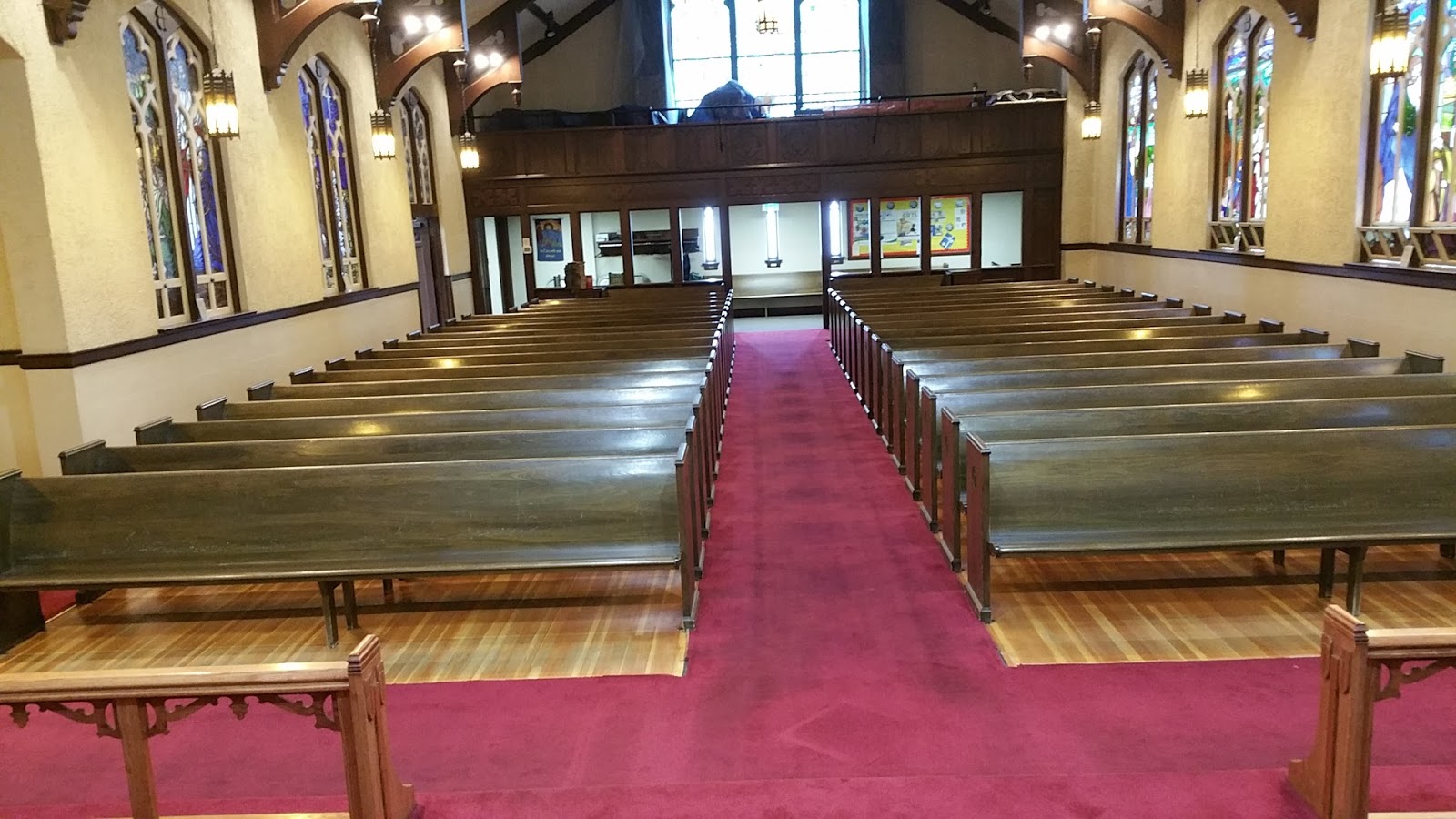
Historic Church Renovation:
Creating Continuity with the Existing Architecture
A commentary on historic church interior design, restoration and
preservation.

There is a fundamental problem with the way many historic
church renovation projects are approached today: the interior is often treated
as though it exists independently of the building that contains it.
It doesn't.
When you walk up to the façade of an old church, you
naturally anticipate what the interior will be like. The architecture
establishes an expectation. Its scale, shapes, proportions, materials, and
period tell you something about what should exist beyond the heavy wooden
entrance doors.
Yet contemporary church decorating can create a disconnect
between the exterior and the interior.
The existing architecture becomes a shell, while the
interior is redesigned according to whatever happens to be the current
decorative trend.
And increasingly, that means that church decorators end up
proposing the same currently popular scheme from church to church repeatedly until
that trend dies.
The
Building Has a History

The Mariners Church Detroit, MI (circa 1840)
The problem begins when the people designing the interior
see only the aspects of the sanctuary that relate to their particular trade.
Painters see surfaces to paint. Decorators see colors and
fabrics. Designers see a palette and a composition.
But a historic church is more than the sum of those
elements.
It is an existing building with an existing architectural
language.
That means the first step should be understanding what the
church originally was.
The only time a church's exterior and interior are perfectly
aligned with each other is when the church is first built. That doesn't mean
that a historic church has to remain frozen in that original moment. It does
mean that the original relationship between the exterior, the interior, the
architecture, and the materials can help us understand the building.
The objective isn't necessarily to recreate the past.
It is to maintain continuity with it.
That distinction matters.
Continuity
Doesn't Mean Re-creation
A church that is 140 years old has lived a life since the
day it was constructed.
Its worship has changed. Its congregation has changed. Its
needs have changed.

So the question isn't simply, "What did this church look like when it was built?"
The more useful question is, "What is the character of
this building, and how can today's work remain in conversation with it?"
That requires looking at the existing historic elements as
more than obstacles to a new decorative scheme.
It means identifying the interior architectural components
that still have value and determining what can be retained without interfering
with the liturgy or the action taking place in the space.
When that happens, contemporary needs and historic
architecture don't have to be enemies.
They can coexist.
The 1970s
and 1980s Problem
This is particularly relevant to a current trend toward
putting Gothic interiors into churches built during the 1970s and 1980s.
I understand why this is happening.
The stripping away of ornate interiors in the 1970s and
'80s, particularly in response to changes following Vatican II, left many
churches with interiors that their congregations now feel have lost something
important.
There is a historical reaction taking place.
In a broader architectural sense, it is another version of
the Bauhaus minimalist response to the superfluous decoration of Victorianism
and beautifully elaborate Art Nouveau: one period rejecting the aesthetic of
another.
But the response can create another problem.
When a Gothic interior is inserted into a 1970s or 1980s
church, the architecture of that later period can be treated as though it has
no value whatsoever.
There are many more recent churches whose architecture may
not yet be considered historic. But that does not mean their existing
architecture can simply be denied.
Every period produces buildings that eventually become part
of architectural history.
The fact that we may not yet have enough distance from a
particular period to call its buildings "historic" doesn't mean that
those buildings have no architectural value.
Preservation and the Life of the Church

Divine Word Church Techny, IL
There has been an ongoing battle between liturgical needs
and historic preservation for too long.
And there really doesn't need to be.
The important and “contributing” historic elements of a
sacred space can be retained without interfering with the liturgy. The existing
architecture doesn't have to be treated as an obstacle
Preservationists don't have to be treated as a threat.
And decoration doesn't have to erase what came before it.
In fact, understanding and preserving those elements can
create a deeper relationship between the building and the people who worship
within it.
A long history of worship in a beautiful sacred space is a
different experience because it connects the present congregation with the
people who came before them.
Your community is greater than just those who currently
attend.
It includes everyone who has attended that space throughout
its history.
And it includes everyone who shares your beliefs, past and
present.
That is the larger meaning of continuity.
A historic church is not simply an old building that happens
to contain a contemporary congregation.
It is a place where the present exists within a much longer
story.
The challenge is for the church to continue to be an active, vibrant place in the community where people come and go often.
It’s a continuing story.
When the existing architecture is understood first, the interior and exterior can once again have a sense of belonging to one another.

The same can be said of the people of the past and the people of the present.
Your Sacred Space is saying something.
Our job is to listen to it.